Specialty fonts
In addition to the handwriting fonts, our DVDs contains 36 "Specialty fonts." The font names are Ball-and-stick, Ball-and-stick with Rules, Braille 24, Braille 24 Hollow, Clocks, Dashes, Dashes with Rules, EFI Count Dots on Numbers, EFI Direct Instruction, EFI Music Symbols, Emo-faces and Emo-Faces No Words, Fingerletters and Fingerletters with Key, Lettersound Pictures and Lettersound Pictures with Key, Morse Code, Pastor Hausley's 6 Rules, Phonetics Phont, POSTNET-16, four Prewriting Practice variations, and 12 Dysfunctional Letterforms fonts.
To see more of the shapes, just click on the box containing the sample.
You can download the file EFI_specialty_fonts.pdf and print it on your computer. Downloading this file does not install the fonts on your computer. To open the file, use Adobe Acrobat Reader, version 3.0 or higher. You can obtain Adobe Acrobat Reader from the Adobe web site, https://www.adobe.com.
1. The four Ball-and-stick and Dashes fonts are letters made up from lines and circles. They are intended for Special Ed and OT kids. They are NOT D'Nealian style, Zaner-Bloser style, Harcourt Brace style, McDougal, Littell, or any other style.


2. Braille 24 and Braille 24 Hollow are a Level 1 Braille, meant as an introduction. It comes in both solid and hollow forms, the hollow being visually more accurate of embosser output. It can be used to introduce Braille to visually-impaired students.
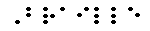
3. Clocks is a font (!) that allows insertion of a clock face into a worksheet. Far out!

4. EFI Count Dots on Numbers is designed to help children learn their numbers.

If you like the idea of Count Dots on Numbers, look at a company called TouchMath. You can find TouchMath, a well-known and complete multi-sensory program with strategically placed TouchPoints on numbers, by going to www.TouchMath.com or calling 1-800-888-9191.
5. EFI Direct Instruction. This teaching method was developed by Zig Englemann. For more information, see http://darkwing.uoregon.edu/~adiep/ft/grossen.htm.

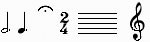
6. EFI Music Symbols. This font was designed by Patsy Lane, a wonderful teacher of music. It is intended as symbol recognition only, and is not usable for composing.
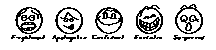
7. Emo-faces is a large set of little circle faces that show an emotion. We have two variations - one has the word for each emotion, and the other is without words. Think Asperger kids who cannot read faces well, and think of putting up two emotions side by side and asking the Aspie what the differences are.
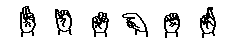
8. Fingerletters is an introduction to American Sign Language. Fingerletters also has two variations, one with the name of the letter, one without.
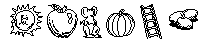
9. Lettersound Pictures is a set of pictures that portray the sounds the letters make. Phonics-like. Lettersound Pictures also has two variations, one with the name of the letter, one without.
10. Morse Code is simply that. Kind of antiquated in the real world, but fun for a rainy-day decoding exercise.

11. Pastor Hausley 6 Rules font
Pastor Hausley is the founder of the Eagle's Nest Christian Academy, and an educator of many students. She suggests that if the students can master certain strokes, forming letters becomes much easier.
12. Phonetics Phont is made up of special characters that allow dictionary-like spelling of words. This is a font that a linguist can use to do American English dictionary pronunciations of words.

Installing the Specialty fonts group that includes the Phonetics Phont also installs the document that describes how to use the font. Please note that this is a Phonetics font, not a Phonics font.
If you want phonics, each of our handwriting font families (except Russian and LG) include Phonics Manuscript variations (long, short, silent, and combinations). See the descriptions of the handwriting fonts for more information.
13. POSTNET-16 is the bar code that you see on the mail that the Post Office delivers. My daughter's 4th grade class did a hands-up/hands-down exhibition to show how the long bars and short bars make up a USPS bar code prior to a field trip to a major regional processing facility. Most of the students had fun. The USPS workers and tour guides were boggled that the 4th graders knew how bar codes worked.

14. Prewriting Practice is just that - characters that will help a beginning writer make the small hand motions to be successful when forming letters and words. The uppercase letters A-T contain diagonal lines, circles, half circles, and so on. Of note is N, which contains a simple circle, but which, if typed over and over, will overlap to give the slinky-like exercise that A. N. Palmer made famous in teaching handwriting. The lower case letters a-z contain repeating, linking letters in a Palmer-like cursive. Typing ooooo, for example, will give a series of linked o's to replicate. Note that the pre-writer does not need to know that what she is copying is actually letters. Just copy the shape, and the small-hand motions gets trained. This font comes in plain, with Rules, Outlines, and Dots. Using the plain font (or with Rules) with a colored pencil might give excellent results. 
15. Dysfunctional Letterforms is a set of 12 fonts that could be used by an OT when preparing reports on the computer that show how a child is not forming letters correctly (reversals, upside down letters, etc). No longer does the OT have to print out a copy of the description, handwrite the problem letters, scan it back in, etc. Click here to see samples of each of the 12 fonts.
Order Form
EFI home page